

Thursday, April 7, 2011
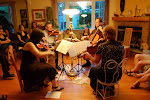
The Adorno quartet forges ahead!
A brief update on the activities of the Adorno Quartet. We are continuing to play Beethoven, and adding a few other works to our repertoire in the meantime. Upcoming events include an event at the Phelps Mansion in Binghamton, NY on May 15th, with Op.18 #5 and Op.59 #3, with the theme being "Mozart's Spirit from Haydn's hands". In July we're at the Westben Arts Theatre in Campbellford, Ontario for a concert with Andre Laplante which includes Haydn Op. 20 #4, Bartok Third Quartet, and the Brahms Piano Quintet, Op. 34. In August we appear at the Maison Trestler, in Vaudreuil-Dorion, the program includes Haydn Op.20 #4, Bartok Third Quartet, and Beethoven's Op.59 #3.


Beethoven and Schubert - Intersections
In advance of the upcoming release of the New Orford String Quartet's debut recording of Beethoven's Op.135 and Schubert's D.887 in G major, I would like to share some thoughts about Beethoven and Schubert. The recording will be released on Bridge Records in the summer of 2011.
In our time, Beethoven and Schubert can hardly be separated from each other. They have become intertwined in a way that they never were during their lives. In spite of sharing the same city streets during the same epoch and making acquaintances with many of the same people, they never had any direct contact. Part of this is easily explained by the difference in their ages, twenty-six years. By the time Schubert was beginning his musical career, Beethoven was already very famous, almost completely deaf, and because of this, increasingly shut off from society. The two quartets on this disc were composed in the same year, 1826; in the same city, Vienna; apparently in splendid isolation from each other.
Vienna in the early 19th century had a population of around 300,000. In a city of this size one would expect that two musicians would cross paths in the course of daily life, but that is not the case. The points of intersection between the two men are few. As the imperial capitol of the Austrian Empire, Vienna had been subjected to a brief siege by Napoleon in 1809. Schubert was a schoolboy, and witnessed the damage to his school building from the shelling. During the bombardment, Beethoven retreated to his brother's cellar and held pillows over his ears, desperately trying to prevent further damage to his hearing.
Both composers lived with serious personal afflictions which color their existence, causing social isolation and an inward retreat: Beethoven's deafness, and Schubert's venereal disease.
Both men worked with the violinist Ignaz Schuppanzigh and his string quartet, but the relationship between the two composers and the violinist couldn't have been more different. Beethoven dominated Schuppanzigh, laughing at him when he struggled to play something Beethoven had written, writing a joking little song about Schuppanzigh being a “fat lump.” Schubert, on the other hand, was deferential. He had no response to Schuppanzigh's criticisms of the violin writing in the “Death and the Maiden” quartet; “my dear fellow, this is no good, leave it alone; you stick to your songs.”
Both men responded to Anton Diabelli's call in 1819 for composers to write a variation on his waltz theme. Schubert was one of the very first eager respondants, with a single very fine variation. Beethoven took this as an opportunity to singlehandedly outcompose all those responding by writing a massive work, four years in the making, and very pointedly one variation longer than the great Goldberg variations of J.S. Bach.
There are moments when the two men crossed paths, but surprisingly no direct contact can be established. We know that Beethoven was aware of the younger Schubert. In an 1823 conversation book entry, Beethoven's nephew Karl comments - “They greatly praise Schubert, but it is said that he hides himself.” Schubert was on hand at the legendary premiere of Beethoven's 9th symphony, an event that resonated enough for Schubert to quote the “Ode to Joy” theme in his own 9th symphony. Schubert was also present at the 1826 premiere of Beethoven's string quartet Op.130, at which some movements were well received and had to be repeated for the enthusiastic audience, but the last movement, the still controversial “Grosse Fuge,” was not understood at all. One wonders what Schubert thought of the performance.
During Beethoven's final months, Anton Schindler presented the bedridden composer with a collection of about 60 of Schubert's songs. According to Schindler, Beethoven was “amazed at the number of them,” and “utterly astonished when he got to know their content.” He “simply could not believe that at that time Schubert had written over 500 songs.” Beethoven, quoting Schiller's “Ode” himself, said “Truly, in Schubert there dwells a divine spark!” and pronounced “that he will still make a great stir in the world.” A month later, Schubert was one of the many torch bearers in Beethoven's epic funeral procession.
A year and a half later, in 1828, during Schubert's own final illness, the bedridden Schubert asked for Beethoven's string quartet Op.131 to be played in his tiny, sad chambers. After the musicians, including Karl Holz, the long time second violin of Schuppanzigh's quartet, finished playing, Schubert is reported to have said of Beethoven – “He's left us nothing else to write.” Schubert's wish to be buried next to Beethoven was finally fulfilled in 1888, sixty years after his death, when the two men were moved to new graves, still in Vienna, side by side for eternity.
In our time, Beethoven and Schubert can hardly be separated from each other. They have become intertwined in a way that they never were during their lives. In spite of sharing the same city streets during the same epoch and making acquaintances with many of the same people, they never had any direct contact. Part of this is easily explained by the difference in their ages, twenty-six years. By the time Schubert was beginning his musical career, Beethoven was already very famous, almost completely deaf, and because of this, increasingly shut off from society. The two quartets on this disc were composed in the same year, 1826; in the same city, Vienna; apparently in splendid isolation from each other.
Vienna in the early 19th century had a population of around 300,000. In a city of this size one would expect that two musicians would cross paths in the course of daily life, but that is not the case. The points of intersection between the two men are few. As the imperial capitol of the Austrian Empire, Vienna had been subjected to a brief siege by Napoleon in 1809. Schubert was a schoolboy, and witnessed the damage to his school building from the shelling. During the bombardment, Beethoven retreated to his brother's cellar and held pillows over his ears, desperately trying to prevent further damage to his hearing.
Both composers lived with serious personal afflictions which color their existence, causing social isolation and an inward retreat: Beethoven's deafness, and Schubert's venereal disease.
Both men worked with the violinist Ignaz Schuppanzigh and his string quartet, but the relationship between the two composers and the violinist couldn't have been more different. Beethoven dominated Schuppanzigh, laughing at him when he struggled to play something Beethoven had written, writing a joking little song about Schuppanzigh being a “fat lump.” Schubert, on the other hand, was deferential. He had no response to Schuppanzigh's criticisms of the violin writing in the “Death and the Maiden” quartet; “my dear fellow, this is no good, leave it alone; you stick to your songs.”
Both men responded to Anton Diabelli's call in 1819 for composers to write a variation on his waltz theme. Schubert was one of the very first eager respondants, with a single very fine variation. Beethoven took this as an opportunity to singlehandedly outcompose all those responding by writing a massive work, four years in the making, and very pointedly one variation longer than the great Goldberg variations of J.S. Bach.
There are moments when the two men crossed paths, but surprisingly no direct contact can be established. We know that Beethoven was aware of the younger Schubert. In an 1823 conversation book entry, Beethoven's nephew Karl comments - “They greatly praise Schubert, but it is said that he hides himself.” Schubert was on hand at the legendary premiere of Beethoven's 9th symphony, an event that resonated enough for Schubert to quote the “Ode to Joy” theme in his own 9th symphony. Schubert was also present at the 1826 premiere of Beethoven's string quartet Op.130, at which some movements were well received and had to be repeated for the enthusiastic audience, but the last movement, the still controversial “Grosse Fuge,” was not understood at all. One wonders what Schubert thought of the performance.
During Beethoven's final months, Anton Schindler presented the bedridden composer with a collection of about 60 of Schubert's songs. According to Schindler, Beethoven was “amazed at the number of them,” and “utterly astonished when he got to know their content.” He “simply could not believe that at that time Schubert had written over 500 songs.” Beethoven, quoting Schiller's “Ode” himself, said “Truly, in Schubert there dwells a divine spark!” and pronounced “that he will still make a great stir in the world.” A month later, Schubert was one of the many torch bearers in Beethoven's epic funeral procession.
A year and a half later, in 1828, during Schubert's own final illness, the bedridden Schubert asked for Beethoven's string quartet Op.131 to be played in his tiny, sad chambers. After the musicians, including Karl Holz, the long time second violin of Schuppanzigh's quartet, finished playing, Schubert is reported to have said of Beethoven – “He's left us nothing else to write.” Schubert's wish to be buried next to Beethoven was finally fulfilled in 1888, sixty years after his death, when the two men were moved to new graves, still in Vienna, side by side for eternity.
Thursday, June 3, 2010
Not Lead Poisoning!
Just after delivering the diagnosis in Part Six that Beethoven likely died of lead poisoning, I read that after tests of skull fragments that lead poisoning has been emphatically ruled out as the cause of Beethoven's death! For more go to: http://www.vitabeat.com/8352/lead-poisoning-unlikely-cause-beethovens-death
A brief outline
I thought a brief, but by no means complete, outline of the topics covered in the three years we've been doing this might be interesting:
Part 1: Absolute Music as Philosophy and Religion. Economics in music ca. 1800
Part 2: The Enlightenment and Classical Greece. Orpheus and his “Eternal Recurrence”, Waldstein's “Mozart's spirit from the hands of Haydn.” Wagner's program for Op.131 and our first taste of Faust and Goethe.
Part 3: Fame and fortune in the salons of Vienna, the 1790's piano duels or “battle of the bands”. Beethoven contra Napoleon. The Heiligenstadt testament and the patterns of death and rebirth in Beethoven's “Heroic Style”. The “Grosse Fuge” is it the seed of 20th century music?
Part 4: Beethoven on the comics page: Peanuts. Music for boys and girls: is music Gender coded? Beethoven's love life and mystery of The Immortal Beloved.
Part 5: Mann's “Faustus” and Strauss' “Metamorphosen” - reactions to the catastrophic failure of the Enlightenment and “Bildung”, Clockwork Orange and the “Ode to Sorrow”, Does high culture civilize? Is Beethoven to blame?
Part 6: What other composers have to say about Beethoven. Muss es Sein? Beethoven's death, was that clap of thunder the “Divine Spark of Heaven”?
Part 1: Absolute Music as Philosophy and Religion. Economics in music ca. 1800
Part 2: The Enlightenment and Classical Greece. Orpheus and his “Eternal Recurrence”, Waldstein's “Mozart's spirit from the hands of Haydn.” Wagner's program for Op.131 and our first taste of Faust and Goethe.
Part 3: Fame and fortune in the salons of Vienna, the 1790's piano duels or “battle of the bands”. Beethoven contra Napoleon. The Heiligenstadt testament and the patterns of death and rebirth in Beethoven's “Heroic Style”. The “Grosse Fuge” is it the seed of 20th century music?
Part 4: Beethoven on the comics page: Peanuts. Music for boys and girls: is music Gender coded? Beethoven's love life and mystery of The Immortal Beloved.
Part 5: Mann's “Faustus” and Strauss' “Metamorphosen” - reactions to the catastrophic failure of the Enlightenment and “Bildung”, Clockwork Orange and the “Ode to Sorrow”, Does high culture civilize? Is Beethoven to blame?
Part 6: What other composers have to say about Beethoven. Muss es Sein? Beethoven's death, was that clap of thunder the “Divine Spark of Heaven”?
Nearing the finish line

It's been a long time since I last posted anything on the blog! The quantity and density of the projects I've undertaken in the last year has been somewhat overwhelming. We've passed through part 5, and are now into the sixth and final segment of our three year journey. In the course of doing this, we were even convinced to give a name to our quartet, the Adorno quartet. The reason for this are practical. We played last summer at the Westben Arts Theater, and in advertising the concert, they needed something to call us. They began with "the Jansonius Quartet", but we vetoed that and came up with the somewhat ironic "Adorno" name. We are playing Part 6 eight times in seven different "salons", four straight weeks of Beethoven quartets! I am also in another quartet, more commercially oriented, the "New Orford String Quartet". On top of this, I decided to record and perform all the Bach cello suites this year. The recording and editing is finished, and the CD will be released June 27th, 2010. What was I thinking? This is a huge undertaking! I will be performing them along with Eric Siblin, the author of "The Cello Suites" at the first Festival ALexandria concert on June 27th. In the course of this, I started my own recording company, STORKCLASSICS!
Wednesday, November 18, 2009
Part Five coming soon...
Only two quartets will be presented in this segment. The subject on my mind is Culture vs. Barbarism. Does "culture" civilize? It seems that the view on this has changed quite a bit since Beethoven's time.
Friday, June 5, 2009
Part Four begins today!
We're starting the fourth of our six part Beethoven cycle today. The topic this time centers on Beethoven's love life. It should be interesting!
Sunday, March 22, 2009
In Memoriam
This is in memory of all the newspapers like the Seattle Post-Intelligencer that are leaving behind the printed word in favor of the internet. It seems evident that Blogs are one source of the difficulty for the newspapers. Everyone is writing! These writers may not have many readers individually, but the sheer number of them has contributed to the demise of the old-fashioned newspaper. In 1936, Walter Benjamin writes prophetically in his essay "The Work of Art in the Age of Its Technical Reproducibilty": "For centuries it was in the nature of literature that a small number of writers confronted many thousands of readers. This began to change toward the end of the past (19th)century. With the growth and extension of the press, which constantly made new political, religious, scientific, professional, and local journals available to readers, an increasing number of readers-in isolated cases, at first-turned into writers. It began with the space set aside for "letters to the editor" in the daily press, and has now reached a point where there is hardly a European engaged in the work process who could not, in principle, find an opportunity to publish somewhere or other an account of a work experience, a complaint, a report, or something of the kind...At any moment, the reader is ready to become a writer." With so many more writers, and the same number of readers, there is now a phenomenon that has been called "internet solitude" by a friend. Those of you who are posting blogs know this feeling!
Sunday, February 8, 2009
Time in Music
Robert Schumann wrote about the third in a triad mediating past, present, and future. What does this mean? Does music have past, present and future tenses like spoken language? In language a distinction is made between temporal things (like natural processes and historical happenings) and non-temporal things (like spatial and numerical relations). Music certainly has spatial and proportional relations that correspond to these non-temporal types of things. Music also uses the passage of time as an element of space and proportion. How can a composer communicate differences in time? In Mahler's sixth symphony, there is a fanfare-like A major chord that dissolves to minor. Could this perhaps be changing the sense of time from present (life) to future (death)? Mahler is particularly fond of this shifting from major to minor. Das Lied von der Erde is full of examples of this device, and it's interesting to compare the text with the occurrence of these harmonic shifts.
Another aspect of time in music is bound up with the way we perceive it unfolding during performance. Music follows the “arrow of time” in linear fashion, and many pieces use this perception to create a sense of narrative line. Beethoven in his middle period constructs energetic and clear narratives that follow the “arrow of time” in a very direct way. In his late works, this linear process is disrupted in ways more complex than simply changing where the third lies in relation to its neighbors in a triad. Beethoven takes motivic development to a very deep level, allowing him to create structures that contain an ambiguity in the “arrow of time” by disrupting it. A good example of this is the first movement of the Op.132 string quartet. The movement begins with a sort of cantus firmus, very objective in character, which is interrupted by an outburst of subjectivity which seems to have no relation, but in fact is made up of the same musical material as the cantus firmus. Another favorite method in the late works is to use an amalgam of different musical genres. In using different historical styles, Beethoven is making allusion to different historical time frames. For example, a minuet in Beethoven's time is already a musical genre from the past, and his choice of such a genre has
significance in terms of past, present and future.
Another aspect of time in music is bound up with the way we perceive it unfolding during performance. Music follows the “arrow of time” in linear fashion, and many pieces use this perception to create a sense of narrative line. Beethoven in his middle period constructs energetic and clear narratives that follow the “arrow of time” in a very direct way. In his late works, this linear process is disrupted in ways more complex than simply changing where the third lies in relation to its neighbors in a triad. Beethoven takes motivic development to a very deep level, allowing him to create structures that contain an ambiguity in the “arrow of time” by disrupting it. A good example of this is the first movement of the Op.132 string quartet. The movement begins with a sort of cantus firmus, very objective in character, which is interrupted by an outburst of subjectivity which seems to have no relation, but in fact is made up of the same musical material as the cantus firmus. Another favorite method in the late works is to use an amalgam of different musical genres. In using different historical styles, Beethoven is making allusion to different historical time frames. For example, a minuet in Beethoven's time is already a musical genre from the past, and his choice of such a genre has
significance in terms of past, present and future.
Sunday, January 25, 2009
What is a Cello?
What is a cello? The dictionary says it's “the second largest member of the violin family, rested vertically on the floor between the performer's knees when being played. Also called violoncello”. The word “cello” is a shortened version of the Italian word violoncello, which is not related to the violin at all, but rather the violone, the Italian word for double bass combined with the diminutive cello,
meaning “small bass”. The English “cello” is a recent shortening of violoncello, dating from the 1870's.
The cello as Thing is much more than these simple definitions imply. What does the cello-character of the cello consist of? It consists of wood, at least three kinds. In older times woods like poplar, lime, pear, and cedar were used for the back and sides; rosewood for the fingerboard. Today preference is given to Bosnian Spruce from the Balkan peninsula for the top, Italian Maple for the back and sides,
and exotic tropical Ebony for the fingerboard. These woods each have their own distinct character.
Spruce is light and strong, flexible and resonant. Maple is harder, reflective and stable. Ebony is dense, not porous and changeable. These woods grow from the Earth, the source of all materials for building and making, the place to which all materials return when they no longer are Things. The trees are nourished by the Sky, the location of the Heavens and Divinities, of the Sun and the Rain and the Moon. All these qualities are combined in the woods of a cello. In older times, the wood might have passed through the port of Venice, mixed together with the same woods that the long oars of gondolas are fashioned from. The wood is shaped by chisel and gouge and scraper by the human hands of the maker. The maker must possess great technique. This is not simple handicraft, but the Greek techne, to make something appear.
The Spruce is the front of the cello, the open expressive side that shares: the face. The Sun, Moon and Stars inhabit this region. The Maple is the back and sides, the frame that supports and gives strength: the spine. The roots that anchor in the Earth find their place here. The Ebony is the fingerboard, a Cartesian surface without coordinates, a smooth surface for fingers to travel on: the dwelling place. The cello has a neck, a long neck for the hand to travel along, to caress and to hold. The cello has a head as well, a nautilus shaped scroll with Golden Mean proportions.
The cello has an endpin to anchor the cello in the earth like the leg of a compass, the center from which the radius is drawn by the cello outward into the World of sound. This circle is like the line the shaman draws in the dirt to enscribe the area of ritual magic.
The cello has strings, formerly of plant fibres, horse hair, or gut; now of metal. Gut strings are sheep intestines, torn from the freshly sacrificed animal and processed. The pain of the violence of cutting and rending is remembered in their sound. Apollo was the first string maker. The tortoise inspired him to make the first lyre. He used the tortoise's own intestines for the strings. Some of the earliest musical instruments uncovered in the tombs of Thebes had gut strings that still made a tone after some two thousand years. Metal strings are chrome, silver, titanium, tungsten. The high temperatures used to form the metal remains in the strings, giving warmth and strength, silver and gold and adamant. The cello has four strings, one for each direction of the compass, one for each of the four dimensions,
including time.
The strings pass over the bridge, the legs of which transmit the vibrations like a liquid earthquake to the front of the cello, to the spruce top.
The soundpost is a simple piece of wood that connects the top and the back, Heaven and Earth, sending the vibrations to the maple back, to the roots of the cello. In French the soundpost is called l'âme, or “the soul”. A small adjustment of this “soul” in relation to the top (Heaven) and the back (Earth) can change the behavior of the cello in a dramatic fashion. The soundpost or soul is the only part that can exist in the inner void of the cello body, suspended between the roots and the sky.
The outer surfaces of the cello are covered with Varnish. Vernisshe in the middle ages, from Old French vernis, from Medieval Latin vernix, an odorous resin, from Late Greek verenike, from Greek Berenike, an ancient city in Libya. Varnish contains a gum or resin mixed with spirits. This combination concentrates the life essence of trees. Varnish has mysterious properties. Varnish penetrates the exposed outer surface of the wood, sealing its pores. Sundried and lustrous, Varnish gives color, the heat of the Sun and the cool of the Moon and the diamond-glitter of the Stars are concentrated in the Varnish.
The strings are set in motion by the fingers, plucked like a guitar, or by the bow, a contraption of wood and hair. In older times the wood of the bow could be ironwood or snakewood. In modern times preference is given to pernambucco, a tropical wood of great strength and lightness. The word Bow comes from bowen, to bend, bouwen, buwen, buhen , from būgan, from Beowulf in 725 AD. The wood of the bow is curved with heat, arched and ready to spring with strength and agility. The hair is from the tail of a horse, and remembers how to jump like its wild ancestors from the plains of Asia, running through the grasslands, barely tolerating a rider, sometimes throwing him off.
The cello is a tool. It's usefulness consists of it's ability to replace the human voice. A cello is a tool for making music. A cello sings, laments, speaks, jokes, whispers. A cello can be a friend, an intimate enemy. A cello can represent, trigger, give testimony. A cello can represent a hero, a father, a lover. A cello can trigger emotions, actions, words. A cello can give testimony, can confess, can witness.
meaning “small bass”. The English “cello” is a recent shortening of violoncello, dating from the 1870's.
The cello as Thing is much more than these simple definitions imply. What does the cello-character of the cello consist of? It consists of wood, at least three kinds. In older times woods like poplar, lime, pear, and cedar were used for the back and sides; rosewood for the fingerboard. Today preference is given to Bosnian Spruce from the Balkan peninsula for the top, Italian Maple for the back and sides,
and exotic tropical Ebony for the fingerboard. These woods each have their own distinct character.
Spruce is light and strong, flexible and resonant. Maple is harder, reflective and stable. Ebony is dense, not porous and changeable. These woods grow from the Earth, the source of all materials for building and making, the place to which all materials return when they no longer are Things. The trees are nourished by the Sky, the location of the Heavens and Divinities, of the Sun and the Rain and the Moon. All these qualities are combined in the woods of a cello. In older times, the wood might have passed through the port of Venice, mixed together with the same woods that the long oars of gondolas are fashioned from. The wood is shaped by chisel and gouge and scraper by the human hands of the maker. The maker must possess great technique. This is not simple handicraft, but the Greek techne, to make something appear.
The Spruce is the front of the cello, the open expressive side that shares: the face. The Sun, Moon and Stars inhabit this region. The Maple is the back and sides, the frame that supports and gives strength: the spine. The roots that anchor in the Earth find their place here. The Ebony is the fingerboard, a Cartesian surface without coordinates, a smooth surface for fingers to travel on: the dwelling place. The cello has a neck, a long neck for the hand to travel along, to caress and to hold. The cello has a head as well, a nautilus shaped scroll with Golden Mean proportions.
The cello has an endpin to anchor the cello in the earth like the leg of a compass, the center from which the radius is drawn by the cello outward into the World of sound. This circle is like the line the shaman draws in the dirt to enscribe the area of ritual magic.
The cello has strings, formerly of plant fibres, horse hair, or gut; now of metal. Gut strings are sheep intestines, torn from the freshly sacrificed animal and processed. The pain of the violence of cutting and rending is remembered in their sound. Apollo was the first string maker. The tortoise inspired him to make the first lyre. He used the tortoise's own intestines for the strings. Some of the earliest musical instruments uncovered in the tombs of Thebes had gut strings that still made a tone after some two thousand years. Metal strings are chrome, silver, titanium, tungsten. The high temperatures used to form the metal remains in the strings, giving warmth and strength, silver and gold and adamant. The cello has four strings, one for each direction of the compass, one for each of the four dimensions,
including time.
The strings pass over the bridge, the legs of which transmit the vibrations like a liquid earthquake to the front of the cello, to the spruce top.
The soundpost is a simple piece of wood that connects the top and the back, Heaven and Earth, sending the vibrations to the maple back, to the roots of the cello. In French the soundpost is called l'âme, or “the soul”. A small adjustment of this “soul” in relation to the top (Heaven) and the back (Earth) can change the behavior of the cello in a dramatic fashion. The soundpost or soul is the only part that can exist in the inner void of the cello body, suspended between the roots and the sky.
The outer surfaces of the cello are covered with Varnish. Vernisshe in the middle ages, from Old French vernis, from Medieval Latin vernix, an odorous resin, from Late Greek verenike, from Greek Berenike, an ancient city in Libya. Varnish contains a gum or resin mixed with spirits. This combination concentrates the life essence of trees. Varnish has mysterious properties. Varnish penetrates the exposed outer surface of the wood, sealing its pores. Sundried and lustrous, Varnish gives color, the heat of the Sun and the cool of the Moon and the diamond-glitter of the Stars are concentrated in the Varnish.
The strings are set in motion by the fingers, plucked like a guitar, or by the bow, a contraption of wood and hair. In older times the wood of the bow could be ironwood or snakewood. In modern times preference is given to pernambucco, a tropical wood of great strength and lightness. The word Bow comes from bowen, to bend, bouwen, buwen, buhen , from būgan, from Beowulf in 725 AD. The wood of the bow is curved with heat, arched and ready to spring with strength and agility. The hair is from the tail of a horse, and remembers how to jump like its wild ancestors from the plains of Asia, running through the grasslands, barely tolerating a rider, sometimes throwing him off.
The cello is a tool. It's usefulness consists of it's ability to replace the human voice. A cello is a tool for making music. A cello sings, laments, speaks, jokes, whispers. A cello can be a friend, an intimate enemy. A cello can represent, trigger, give testimony. A cello can represent a hero, a father, a lover. A cello can trigger emotions, actions, words. A cello can give testimony, can confess, can witness.
Sunday, January 18, 2009
What is a composer for?
What is a composer for? What exactly does he do? This question has many answers, depending on the intended use or purpose of the composition. For now, I will ignore our technological age and concentrate on the 18th and 19th century. Some composers were writing music for a specific occasion. This can be something as simple as writing music for background, to cover the clatter of dinnerware in the dining room of a royal patron. This is like musical wallpaper. Boccherini comes to mind in this case. Some are writing music to support a theological position. Bach is like this. Some are trying to convey some sort of narrative line, like a literary novel. Tchaikovsky is of this sort. Some composers are linking music with political and social issues. Wagner is like this. The most difficult task for a composer is to write music that aspires to the same type of expression as poetry. These composers are trying to share inner states of experience, inner truths that require them to turn themselves inside out, baring themselves in an unshielded way to all of us. Beethoven is like this. The “sounding inwardness” of his deafness must have been very deep, practically bottomless. In this way Beethoven is the first Romantic composer. Schumann tries with all his might to link poetic states with musical expression. Mahler was trying to write his inner experience of the whole world into his compositions. The unshielded quality of the composition requires of a performer that they also turn themselves inside out and share their inner experience of the music they are performing. I'm not talking about making faces or looking up to the heavens for “inspiration” during key points of a performance. Performers who do not fully embrace their responsibility to empathize and live in the recreation of the inner states of these kinds of works are not just siding with Apollo, they are missing the point. In Rilke's first “Sonnet to Orpheus” he writes:
A tree ascended there. O pure transcendence!
Oh Orpheus sings! Oh tall tree in the ear!
Orpheus represents the artist who is always turned inside out. This is talking about “sounding inwardness” and its internal growth and eventual outward expression.
A tree ascended there. O pure transcendence!
Oh Orpheus sings! Oh tall tree in the ear!
Orpheus represents the artist who is always turned inside out. This is talking about “sounding inwardness” and its internal growth and eventual outward expression.
Saturday, January 10, 2009
Friday, January 9, 2009
Laying down the Law
Performing musicians have something in common with judges. Each receives a traditionary text from an earlier time, and each is obliged to interpret the text in their present circumstances. The Judge and the Musician must immerse themselves in historical research to uncover the original intention of the text. However, no matter how deeply one searchs, the ground has shifted since the original was conceived, and one must interpret the text in the context of ones own time. In both disciplines there is a long history of other interpretations that must be consulted in order to understand the text in question. These interpretive traditions are extremely deep, and require a lifetime of study, there is no quick way to this sort of knowledge! Furthermore, there is no way to go back to a legitimate "original", for it can not exist in Music or in Law. An attempt to recreate the original version results in something like a facsimile of a facsimile, etc. These facsimiles are like the mass produced copies of famous works of art. The fact that time doesn't stand still further complicates the task, as the interpreter must be constantly changing to remain current.
Wednesday, January 7, 2009
Cultic aspects
No, that is not a typographical error, I mean Cultic and not Celtic. "Classical" music is in some ways analogous to religion. Like religion, music is supposed to contain elements that synthesize Man's natural, animal side with the rational, intellectual side. Culture, like religion, is supposed to bind these two tendencies together. We rise up to humanity through culture. The painting of Liszt at the piano clearly shows this metaphor in action. Beethoven is seen as a god figure, Liszt is the priest, and the listeners are receiving the message of the god mediated by the priest. I'm sure you've all noticed the ritualistic aspects of a modern concert hall from time to time.
Saturday, January 3, 2009
Do it yourself
In the age of pre-packaged entertainment, we've forgotten how to make music at home. Here's a list of what you need to do it yourself:
1) Equipment: musical instruments (for a string quartet this means two violins, one viola, one cello, and bows for each instrument), four chairs, four music stands, and music to play from (the "potatoes in a cellar" comes to mind)
2) Four players - in our day and age this can be difficult to come by as we rely more on prepackaged cultural goods. Admittedly there is a certain amount of skill necessary to participate.
If only this was more sporting, we could say "Just Do It!" with a swoosh...
1) Equipment: musical instruments (for a string quartet this means two violins, one viola, one cello, and bows for each instrument), four chairs, four music stands, and music to play from (the "potatoes in a cellar" comes to mind)
2) Four players - in our day and age this can be difficult to come by as we rely more on prepackaged cultural goods. Admittedly there is a certain amount of skill necessary to participate.
If only this was more sporting, we could say "Just Do It!" with a swoosh...
Friday, January 2, 2009
MTV
Nietzsche describes Wagner operas as "deeds of music made visible". Is this really so different than
MTV?
MTV?
Thursday, January 1, 2009
Potatoes in the cellar?
Martin Heidegger writes that "Works of art are shipped like coal from the Ruhr and logs from the Black Forest. During the First World War Holderlin's hymns were packed in the soldier's knapsack together with cleaning gear. Beethoven's quartets lie in the storerooms of the publishing house like potatoes in a cellar." I must admit to having stacks of quartets (not just Beethoven's) in my cellar!
Wednesday, December 31, 2008
The Programs
The Beethoven Quartets
First Evening
Quartet in F Major, Op. 18, No. 1
Quartet in E-flat Major, Op. 127
Quartet in C Major, Op. 59, No. 3
Second Evening
Quartet in E-flat Major, Op. 74 ("The Harp")
Quartet in G Major, Op. 18, No. 2
Quartet in C-sharp minor, Op. 131
Third Evening
Quartet in D Major, Op. 18, No. 3
"Grosse Fugue", Op. 133
Quartet in C Major, Op. 59, No. 1
Fourth Evening
Quartet in F minor, Op. 95 ("Serioso")
Quartet in B-flat Major, Op. 18, No. 6
Quartet in A minor, Op. 132
Fifth Evening
Quartet in A Major, Op. 18, No. 5
Quartet in B-flat Major, Op. 130
Sixth Evening
Quartet in C minor, Op. 18, No. 4
Quartet in E minor, Op. 59, No. 2
Quartet in F Major, Op. 135
Quartet in F Major, Op. 18, No. 1
Quartet in E-flat Major, Op. 127
Quartet in C Major, Op. 59, No. 3
Second Evening
Quartet in E-flat Major, Op. 74 ("The Harp")
Quartet in G Major, Op. 18, No. 2
Quartet in C-sharp minor, Op. 131
Third Evening
Quartet in D Major, Op. 18, No. 3
"Grosse Fugue", Op. 133
Quartet in C Major, Op. 59, No. 1
Fourth Evening
Quartet in F minor, Op. 95 ("Serioso")
Quartet in B-flat Major, Op. 18, No. 6
Quartet in A minor, Op. 132
Fifth Evening
Quartet in A Major, Op. 18, No. 5
Quartet in B-flat Major, Op. 130
Sixth Evening
Quartet in C minor, Op. 18, No. 4
Quartet in E minor, Op. 59, No. 2
Quartet in F Major, Op. 135
Jasmine Schnarr
Jasmine Schnarr began studying the viola with her father at the age of eight. She continued her studies with Mark Childs and then with Yariv Aloni and Dov Scheindlin of the Penderecki String Quartet. Since arriving in Québec in 1997, Jasmine has appeared with the National Arts Centre Orchestra, Les Violons du Roy, the McGill Chamber Orchestra and the Orchestre symphonique de Montréal. She was a member of the Molinari String Quartet from 2002 to 2006.
Katherine Manker
Katherine Manker spent seven seasons as Associate Concertmaster with the North Carolina Symphony, before moving to Montréal. Currently, she is teaching for the McGill Music Conservatory and is an active freelance musician, performing frequently with l'Orchestre symphonique de Montréal. Ms. Manker joined the North Carolina Symphony after spending several years in Southern California, regularly performing with the Santa Barbara Symphony and Chamber Orchestras, Pacific Symphony Orchestra, Opera Pacific, and freelance work in the motion picture, television, and recording industries. She studied with Linda Cerone at the Cleveland Institute of Music where she received her Bachelor of Music degree and continued her violin studies at the R.D. Colburn School of Performing Arts in Los Angeles as a scholarship student of Robert Lipsett. Ms. Manker has taught for the Preparatory Department of the Cleveland Institute of Music, the Ashtabula Arts Center in Ohio, the R.D. Colburn School of Performing Arts, and the University of North Carolina at Chapel Hill. Most recently, she has become the Artistic Coordinator for Festival Alexandria
Subscribe to:
Posts (Atom)