

What is a composer for? What exactly does he do? This question has many answers, depending on the intended use or purpose of the composition. For now, I will ignore our technological age and concentrate on the 18th and 19th century. Some composers were writing music for a specific occasion. This can be something as simple as writing music for background, to cover the clatter of dinnerware in the dining room of a royal patron. This is like musical wallpaper. Boccherini comes to mind in this case. Some are writing music to support a theological position. Bach is like this. Some are trying to convey some sort of narrative line, like a literary novel. Tchaikovsky is of this sort. Some composers are linking music with political and social issues. Wagner is like this. The most difficult task for a composer is to write music that aspires to the same type of expression as poetry. These composers are trying to share inner states of experience, inner truths that require them to turn themselves inside out, baring themselves in an unshielded way to all of us. Beethoven is like this. The “sounding inwardness” of his deafness must have been very deep, practically bottomless. In this way Beethoven is the first Romantic composer. Schumann tries with all his might to link poetic states with musical expression. Mahler was trying to write his inner experience of the whole world into his compositions. The unshielded quality of the composition requires of a performer that they also turn themselves inside out and share their inner experience of the music they are performing. I'm not talking about making faces or looking up to the heavens for “inspiration” during key points of a performance. Performers who do not fully embrace their responsibility to empathize and live in the recreation of the inner states of these kinds of works are not just siding with Apollo, they are missing the point. In Rilke's first “Sonnet to Orpheus” he writes:
A tree ascended there. O pure transcendence!
Oh Orpheus sings! Oh tall tree in the ear!
Orpheus represents the artist who is always turned inside out. This is talking about “sounding inwardness” and its internal growth and eventual outward expression.
Sunday, January 18, 2009


Saturday, January 10, 2009
Friday, January 9, 2009
Laying down the Law
Performing musicians have something in common with judges. Each receives a traditionary text from an earlier time, and each is obliged to interpret the text in their present circumstances. The Judge and the Musician must immerse themselves in historical research to uncover the original intention of the text. However, no matter how deeply one searchs, the ground has shifted since the original was conceived, and one must interpret the text in the context of ones own time. In both disciplines there is a long history of other interpretations that must be consulted in order to understand the text in question. These interpretive traditions are extremely deep, and require a lifetime of study, there is no quick way to this sort of knowledge! Furthermore, there is no way to go back to a legitimate "original", for it can not exist in Music or in Law. An attempt to recreate the original version results in something like a facsimile of a facsimile, etc. These facsimiles are like the mass produced copies of famous works of art. The fact that time doesn't stand still further complicates the task, as the interpreter must be constantly changing to remain current.
Wednesday, January 7, 2009
Cultic aspects
No, that is not a typographical error, I mean Cultic and not Celtic. "Classical" music is in some ways analogous to religion. Like religion, music is supposed to contain elements that synthesize Man's natural, animal side with the rational, intellectual side. Culture, like religion, is supposed to bind these two tendencies together. We rise up to humanity through culture. The painting of Liszt at the piano clearly shows this metaphor in action. Beethoven is seen as a god figure, Liszt is the priest, and the listeners are receiving the message of the god mediated by the priest. I'm sure you've all noticed the ritualistic aspects of a modern concert hall from time to time.
Saturday, January 3, 2009
Do it yourself
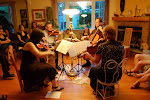
In the age of pre-packaged entertainment, we've forgotten how to make music at home. Here's a list of what you need to do it yourself:
1) Equipment: musical instruments (for a string quartet this means two violins, one viola, one cello, and bows for each instrument), four chairs, four music stands, and music to play from (the "potatoes in a cellar" comes to mind)
2) Four players - in our day and age this can be difficult to come by as we rely more on prepackaged cultural goods. Admittedly there is a certain amount of skill necessary to participate.
If only this was more sporting, we could say "Just Do It!" with a swoosh...
1) Equipment: musical instruments (for a string quartet this means two violins, one viola, one cello, and bows for each instrument), four chairs, four music stands, and music to play from (the "potatoes in a cellar" comes to mind)
2) Four players - in our day and age this can be difficult to come by as we rely more on prepackaged cultural goods. Admittedly there is a certain amount of skill necessary to participate.
If only this was more sporting, we could say "Just Do It!" with a swoosh...
Friday, January 2, 2009
MTV
Nietzsche describes Wagner operas as "deeds of music made visible". Is this really so different than
MTV?
MTV?
Thursday, January 1, 2009
Potatoes in the cellar?
Martin Heidegger writes that "Works of art are shipped like coal from the Ruhr and logs from the Black Forest. During the First World War Holderlin's hymns were packed in the soldier's knapsack together with cleaning gear. Beethoven's quartets lie in the storerooms of the publishing house like potatoes in a cellar." I must admit to having stacks of quartets (not just Beethoven's) in my cellar!
Subscribe to:
Posts (Atom)