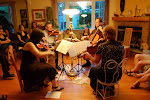


I thought a brief, but by no means complete, outline of the topics covered in the three years we've been doing this might be interesting:
Part 1: Absolute Music as Philosophy and Religion. Economics in music ca. 1800
Part 2: The Enlightenment and Classical Greece. Orpheus and his “Eternal Recurrence”, Waldstein's “Mozart's spirit from the hands of Haydn.” Wagner's program for Op.131 and our first taste of Faust and Goethe.
Part 3: Fame and fortune in the salons of Vienna, the 1790's piano duels or “battle of the bands”. Beethoven contra Napoleon. The Heiligenstadt testament and the patterns of death and rebirth in Beethoven's “Heroic Style”. The “Grosse Fuge” is it the seed of 20th century music?
Part 4: Beethoven on the comics page: Peanuts. Music for boys and girls: is music Gender coded? Beethoven's love life and mystery of The Immortal Beloved.
Part 5: Mann's “Faustus” and Strauss' “Metamorphosen” - reactions to the catastrophic failure of the Enlightenment and “Bildung”, Clockwork Orange and the “Ode to Sorrow”, Does high culture civilize? Is Beethoven to blame?
Part 6: What other composers have to say about Beethoven. Muss es Sein? Beethoven's death, was that clap of thunder the “Divine Spark of Heaven”?
Thursday, June 3, 2010


Nearing the finish line

It's been a long time since I last posted anything on the blog! The quantity and density of the projects I've undertaken in the last year has been somewhat overwhelming. We've passed through part 5, and are now into the sixth and final segment of our three year journey. In the course of doing this, we were even convinced to give a name to our quartet, the Adorno quartet. The reason for this are practical. We played last summer at the Westben Arts Theater, and in advertising the concert, they needed something to call us. They began with "the Jansonius Quartet", but we vetoed that and came up with the somewhat ironic "Adorno" name. We are playing Part 6 eight times in seven different "salons", four straight weeks of Beethoven quartets! I am also in another quartet, more commercially oriented, the "New Orford String Quartet". On top of this, I decided to record and perform all the Bach cello suites this year. The recording and editing is finished, and the CD will be released June 27th, 2010. What was I thinking? This is a huge undertaking! I will be performing them along with Eric Siblin, the author of "The Cello Suites" at the first Festival ALexandria concert on June 27th. In the course of this, I started my own recording company, STORKCLASSICS!
Wednesday, November 18, 2009
Part Five coming soon...
Only two quartets will be presented in this segment. The subject on my mind is Culture vs. Barbarism. Does "culture" civilize? It seems that the view on this has changed quite a bit since Beethoven's time.
Friday, June 5, 2009
Part Four begins today!
We're starting the fourth of our six part Beethoven cycle today. The topic this time centers on Beethoven's love life. It should be interesting!
Sunday, March 22, 2009
In Memoriam
This is in memory of all the newspapers like the Seattle Post-Intelligencer that are leaving behind the printed word in favor of the internet. It seems evident that Blogs are one source of the difficulty for the newspapers. Everyone is writing! These writers may not have many readers individually, but the sheer number of them has contributed to the demise of the old-fashioned newspaper. In 1936, Walter Benjamin writes prophetically in his essay "The Work of Art in the Age of Its Technical Reproducibilty": "For centuries it was in the nature of literature that a small number of writers confronted many thousands of readers. This began to change toward the end of the past (19th)century. With the growth and extension of the press, which constantly made new political, religious, scientific, professional, and local journals available to readers, an increasing number of readers-in isolated cases, at first-turned into writers. It began with the space set aside for "letters to the editor" in the daily press, and has now reached a point where there is hardly a European engaged in the work process who could not, in principle, find an opportunity to publish somewhere or other an account of a work experience, a complaint, a report, or something of the kind...At any moment, the reader is ready to become a writer." With so many more writers, and the same number of readers, there is now a phenomenon that has been called "internet solitude" by a friend. Those of you who are posting blogs know this feeling!
Sunday, February 8, 2009
Time in Music
Robert Schumann wrote about the third in a triad mediating past, present, and future. What does this mean? Does music have past, present and future tenses like spoken language? In language a distinction is made between temporal things (like natural processes and historical happenings) and non-temporal things (like spatial and numerical relations). Music certainly has spatial and proportional relations that correspond to these non-temporal types of things. Music also uses the passage of time as an element of space and proportion. How can a composer communicate differences in time? In Mahler's sixth symphony, there is a fanfare-like A major chord that dissolves to minor. Could this perhaps be changing the sense of time from present (life) to future (death)? Mahler is particularly fond of this shifting from major to minor. Das Lied von der Erde is full of examples of this device, and it's interesting to compare the text with the occurrence of these harmonic shifts.
Another aspect of time in music is bound up with the way we perceive it unfolding during performance. Music follows the “arrow of time” in linear fashion, and many pieces use this perception to create a sense of narrative line. Beethoven in his middle period constructs energetic and clear narratives that follow the “arrow of time” in a very direct way. In his late works, this linear process is disrupted in ways more complex than simply changing where the third lies in relation to its neighbors in a triad. Beethoven takes motivic development to a very deep level, allowing him to create structures that contain an ambiguity in the “arrow of time” by disrupting it. A good example of this is the first movement of the Op.132 string quartet. The movement begins with a sort of cantus firmus, very objective in character, which is interrupted by an outburst of subjectivity which seems to have no relation, but in fact is made up of the same musical material as the cantus firmus. Another favorite method in the late works is to use an amalgam of different musical genres. In using different historical styles, Beethoven is making allusion to different historical time frames. For example, a minuet in Beethoven's time is already a musical genre from the past, and his choice of such a genre has
significance in terms of past, present and future.
Another aspect of time in music is bound up with the way we perceive it unfolding during performance. Music follows the “arrow of time” in linear fashion, and many pieces use this perception to create a sense of narrative line. Beethoven in his middle period constructs energetic and clear narratives that follow the “arrow of time” in a very direct way. In his late works, this linear process is disrupted in ways more complex than simply changing where the third lies in relation to its neighbors in a triad. Beethoven takes motivic development to a very deep level, allowing him to create structures that contain an ambiguity in the “arrow of time” by disrupting it. A good example of this is the first movement of the Op.132 string quartet. The movement begins with a sort of cantus firmus, very objective in character, which is interrupted by an outburst of subjectivity which seems to have no relation, but in fact is made up of the same musical material as the cantus firmus. Another favorite method in the late works is to use an amalgam of different musical genres. In using different historical styles, Beethoven is making allusion to different historical time frames. For example, a minuet in Beethoven's time is already a musical genre from the past, and his choice of such a genre has
significance in terms of past, present and future.
Sunday, January 25, 2009
What is a Cello?
What is a cello? The dictionary says it's “the second largest member of the violin family, rested vertically on the floor between the performer's knees when being played. Also called violoncello”. The word “cello” is a shortened version of the Italian word violoncello, which is not related to the violin at all, but rather the violone, the Italian word for double bass combined with the diminutive cello,
meaning “small bass”. The English “cello” is a recent shortening of violoncello, dating from the 1870's.
The cello as Thing is much more than these simple definitions imply. What does the cello-character of the cello consist of? It consists of wood, at least three kinds. In older times woods like poplar, lime, pear, and cedar were used for the back and sides; rosewood for the fingerboard. Today preference is given to Bosnian Spruce from the Balkan peninsula for the top, Italian Maple for the back and sides,
and exotic tropical Ebony for the fingerboard. These woods each have their own distinct character.
Spruce is light and strong, flexible and resonant. Maple is harder, reflective and stable. Ebony is dense, not porous and changeable. These woods grow from the Earth, the source of all materials for building and making, the place to which all materials return when they no longer are Things. The trees are nourished by the Sky, the location of the Heavens and Divinities, of the Sun and the Rain and the Moon. All these qualities are combined in the woods of a cello. In older times, the wood might have passed through the port of Venice, mixed together with the same woods that the long oars of gondolas are fashioned from. The wood is shaped by chisel and gouge and scraper by the human hands of the maker. The maker must possess great technique. This is not simple handicraft, but the Greek techne, to make something appear.
The Spruce is the front of the cello, the open expressive side that shares: the face. The Sun, Moon and Stars inhabit this region. The Maple is the back and sides, the frame that supports and gives strength: the spine. The roots that anchor in the Earth find their place here. The Ebony is the fingerboard, a Cartesian surface without coordinates, a smooth surface for fingers to travel on: the dwelling place. The cello has a neck, a long neck for the hand to travel along, to caress and to hold. The cello has a head as well, a nautilus shaped scroll with Golden Mean proportions.
The cello has an endpin to anchor the cello in the earth like the leg of a compass, the center from which the radius is drawn by the cello outward into the World of sound. This circle is like the line the shaman draws in the dirt to enscribe the area of ritual magic.
The cello has strings, formerly of plant fibres, horse hair, or gut; now of metal. Gut strings are sheep intestines, torn from the freshly sacrificed animal and processed. The pain of the violence of cutting and rending is remembered in their sound. Apollo was the first string maker. The tortoise inspired him to make the first lyre. He used the tortoise's own intestines for the strings. Some of the earliest musical instruments uncovered in the tombs of Thebes had gut strings that still made a tone after some two thousand years. Metal strings are chrome, silver, titanium, tungsten. The high temperatures used to form the metal remains in the strings, giving warmth and strength, silver and gold and adamant. The cello has four strings, one for each direction of the compass, one for each of the four dimensions,
including time.
The strings pass over the bridge, the legs of which transmit the vibrations like a liquid earthquake to the front of the cello, to the spruce top.
The soundpost is a simple piece of wood that connects the top and the back, Heaven and Earth, sending the vibrations to the maple back, to the roots of the cello. In French the soundpost is called l'âme, or “the soul”. A small adjustment of this “soul” in relation to the top (Heaven) and the back (Earth) can change the behavior of the cello in a dramatic fashion. The soundpost or soul is the only part that can exist in the inner void of the cello body, suspended between the roots and the sky.
The outer surfaces of the cello are covered with Varnish. Vernisshe in the middle ages, from Old French vernis, from Medieval Latin vernix, an odorous resin, from Late Greek verenike, from Greek Berenike, an ancient city in Libya. Varnish contains a gum or resin mixed with spirits. This combination concentrates the life essence of trees. Varnish has mysterious properties. Varnish penetrates the exposed outer surface of the wood, sealing its pores. Sundried and lustrous, Varnish gives color, the heat of the Sun and the cool of the Moon and the diamond-glitter of the Stars are concentrated in the Varnish.
The strings are set in motion by the fingers, plucked like a guitar, or by the bow, a contraption of wood and hair. In older times the wood of the bow could be ironwood or snakewood. In modern times preference is given to pernambucco, a tropical wood of great strength and lightness. The word Bow comes from bowen, to bend, bouwen, buwen, buhen , from būgan, from Beowulf in 725 AD. The wood of the bow is curved with heat, arched and ready to spring with strength and agility. The hair is from the tail of a horse, and remembers how to jump like its wild ancestors from the plains of Asia, running through the grasslands, barely tolerating a rider, sometimes throwing him off.
The cello is a tool. It's usefulness consists of it's ability to replace the human voice. A cello is a tool for making music. A cello sings, laments, speaks, jokes, whispers. A cello can be a friend, an intimate enemy. A cello can represent, trigger, give testimony. A cello can represent a hero, a father, a lover. A cello can trigger emotions, actions, words. A cello can give testimony, can confess, can witness.
meaning “small bass”. The English “cello” is a recent shortening of violoncello, dating from the 1870's.
The cello as Thing is much more than these simple definitions imply. What does the cello-character of the cello consist of? It consists of wood, at least three kinds. In older times woods like poplar, lime, pear, and cedar were used for the back and sides; rosewood for the fingerboard. Today preference is given to Bosnian Spruce from the Balkan peninsula for the top, Italian Maple for the back and sides,
and exotic tropical Ebony for the fingerboard. These woods each have their own distinct character.
Spruce is light and strong, flexible and resonant. Maple is harder, reflective and stable. Ebony is dense, not porous and changeable. These woods grow from the Earth, the source of all materials for building and making, the place to which all materials return when they no longer are Things. The trees are nourished by the Sky, the location of the Heavens and Divinities, of the Sun and the Rain and the Moon. All these qualities are combined in the woods of a cello. In older times, the wood might have passed through the port of Venice, mixed together with the same woods that the long oars of gondolas are fashioned from. The wood is shaped by chisel and gouge and scraper by the human hands of the maker. The maker must possess great technique. This is not simple handicraft, but the Greek techne, to make something appear.
The Spruce is the front of the cello, the open expressive side that shares: the face. The Sun, Moon and Stars inhabit this region. The Maple is the back and sides, the frame that supports and gives strength: the spine. The roots that anchor in the Earth find their place here. The Ebony is the fingerboard, a Cartesian surface without coordinates, a smooth surface for fingers to travel on: the dwelling place. The cello has a neck, a long neck for the hand to travel along, to caress and to hold. The cello has a head as well, a nautilus shaped scroll with Golden Mean proportions.
The cello has an endpin to anchor the cello in the earth like the leg of a compass, the center from which the radius is drawn by the cello outward into the World of sound. This circle is like the line the shaman draws in the dirt to enscribe the area of ritual magic.
The cello has strings, formerly of plant fibres, horse hair, or gut; now of metal. Gut strings are sheep intestines, torn from the freshly sacrificed animal and processed. The pain of the violence of cutting and rending is remembered in their sound. Apollo was the first string maker. The tortoise inspired him to make the first lyre. He used the tortoise's own intestines for the strings. Some of the earliest musical instruments uncovered in the tombs of Thebes had gut strings that still made a tone after some two thousand years. Metal strings are chrome, silver, titanium, tungsten. The high temperatures used to form the metal remains in the strings, giving warmth and strength, silver and gold and adamant. The cello has four strings, one for each direction of the compass, one for each of the four dimensions,
including time.
The strings pass over the bridge, the legs of which transmit the vibrations like a liquid earthquake to the front of the cello, to the spruce top.
The soundpost is a simple piece of wood that connects the top and the back, Heaven and Earth, sending the vibrations to the maple back, to the roots of the cello. In French the soundpost is called l'âme, or “the soul”. A small adjustment of this “soul” in relation to the top (Heaven) and the back (Earth) can change the behavior of the cello in a dramatic fashion. The soundpost or soul is the only part that can exist in the inner void of the cello body, suspended between the roots and the sky.
The outer surfaces of the cello are covered with Varnish. Vernisshe in the middle ages, from Old French vernis, from Medieval Latin vernix, an odorous resin, from Late Greek verenike, from Greek Berenike, an ancient city in Libya. Varnish contains a gum or resin mixed with spirits. This combination concentrates the life essence of trees. Varnish has mysterious properties. Varnish penetrates the exposed outer surface of the wood, sealing its pores. Sundried and lustrous, Varnish gives color, the heat of the Sun and the cool of the Moon and the diamond-glitter of the Stars are concentrated in the Varnish.
The strings are set in motion by the fingers, plucked like a guitar, or by the bow, a contraption of wood and hair. In older times the wood of the bow could be ironwood or snakewood. In modern times preference is given to pernambucco, a tropical wood of great strength and lightness. The word Bow comes from bowen, to bend, bouwen, buwen, buhen , from būgan, from Beowulf in 725 AD. The wood of the bow is curved with heat, arched and ready to spring with strength and agility. The hair is from the tail of a horse, and remembers how to jump like its wild ancestors from the plains of Asia, running through the grasslands, barely tolerating a rider, sometimes throwing him off.
The cello is a tool. It's usefulness consists of it's ability to replace the human voice. A cello is a tool for making music. A cello sings, laments, speaks, jokes, whispers. A cello can be a friend, an intimate enemy. A cello can represent, trigger, give testimony. A cello can represent a hero, a father, a lover. A cello can trigger emotions, actions, words. A cello can give testimony, can confess, can witness.
Subscribe to:
Posts (Atom)