

Thursday, June 3, 2010
Not Lead Poisoning!
Just after delivering the diagnosis in Part Six that Beethoven likely died of lead poisoning, I read that after tests of skull fragments that lead poisoning has been emphatically ruled out as the cause of Beethoven's death! For more go to: http://www.vitabeat.com/8352/lead-poisoning-unlikely-cause-beethovens-death


A brief outline
I thought a brief, but by no means complete, outline of the topics covered in the three years we've been doing this might be interesting:
Part 1: Absolute Music as Philosophy and Religion. Economics in music ca. 1800
Part 2: The Enlightenment and Classical Greece. Orpheus and his “Eternal Recurrence”, Waldstein's “Mozart's spirit from the hands of Haydn.” Wagner's program for Op.131 and our first taste of Faust and Goethe.
Part 3: Fame and fortune in the salons of Vienna, the 1790's piano duels or “battle of the bands”. Beethoven contra Napoleon. The Heiligenstadt testament and the patterns of death and rebirth in Beethoven's “Heroic Style”. The “Grosse Fuge” is it the seed of 20th century music?
Part 4: Beethoven on the comics page: Peanuts. Music for boys and girls: is music Gender coded? Beethoven's love life and mystery of The Immortal Beloved.
Part 5: Mann's “Faustus” and Strauss' “Metamorphosen” - reactions to the catastrophic failure of the Enlightenment and “Bildung”, Clockwork Orange and the “Ode to Sorrow”, Does high culture civilize? Is Beethoven to blame?
Part 6: What other composers have to say about Beethoven. Muss es Sein? Beethoven's death, was that clap of thunder the “Divine Spark of Heaven”?
Part 1: Absolute Music as Philosophy and Religion. Economics in music ca. 1800
Part 2: The Enlightenment and Classical Greece. Orpheus and his “Eternal Recurrence”, Waldstein's “Mozart's spirit from the hands of Haydn.” Wagner's program for Op.131 and our first taste of Faust and Goethe.
Part 3: Fame and fortune in the salons of Vienna, the 1790's piano duels or “battle of the bands”. Beethoven contra Napoleon. The Heiligenstadt testament and the patterns of death and rebirth in Beethoven's “Heroic Style”. The “Grosse Fuge” is it the seed of 20th century music?
Part 4: Beethoven on the comics page: Peanuts. Music for boys and girls: is music Gender coded? Beethoven's love life and mystery of The Immortal Beloved.
Part 5: Mann's “Faustus” and Strauss' “Metamorphosen” - reactions to the catastrophic failure of the Enlightenment and “Bildung”, Clockwork Orange and the “Ode to Sorrow”, Does high culture civilize? Is Beethoven to blame?
Part 6: What other composers have to say about Beethoven. Muss es Sein? Beethoven's death, was that clap of thunder the “Divine Spark of Heaven”?
Nearing the finish line

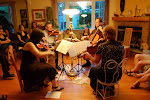
It's been a long time since I last posted anything on the blog! The quantity and density of the projects I've undertaken in the last year has been somewhat overwhelming. We've passed through part 5, and are now into the sixth and final segment of our three year journey. In the course of doing this, we were even convinced to give a name to our quartet, the Adorno quartet. The reason for this are practical. We played last summer at the Westben Arts Theater, and in advertising the concert, they needed something to call us. They began with "the Jansonius Quartet", but we vetoed that and came up with the somewhat ironic "Adorno" name. We are playing Part 6 eight times in seven different "salons", four straight weeks of Beethoven quartets! I am also in another quartet, more commercially oriented, the "New Orford String Quartet". On top of this, I decided to record and perform all the Bach cello suites this year. The recording and editing is finished, and the CD will be released June 27th, 2010. What was I thinking? This is a huge undertaking! I will be performing them along with Eric Siblin, the author of "The Cello Suites" at the first Festival ALexandria concert on June 27th. In the course of this, I started my own recording company, STORKCLASSICS!
Wednesday, November 18, 2009
Part Five coming soon...
Only two quartets will be presented in this segment. The subject on my mind is Culture vs. Barbarism. Does "culture" civilize? It seems that the view on this has changed quite a bit since Beethoven's time.
Friday, June 5, 2009
Part Four begins today!
We're starting the fourth of our six part Beethoven cycle today. The topic this time centers on Beethoven's love life. It should be interesting!
Sunday, March 22, 2009
In Memoriam
This is in memory of all the newspapers like the Seattle Post-Intelligencer that are leaving behind the printed word in favor of the internet. It seems evident that Blogs are one source of the difficulty for the newspapers. Everyone is writing! These writers may not have many readers individually, but the sheer number of them has contributed to the demise of the old-fashioned newspaper. In 1936, Walter Benjamin writes prophetically in his essay "The Work of Art in the Age of Its Technical Reproducibilty": "For centuries it was in the nature of literature that a small number of writers confronted many thousands of readers. This began to change toward the end of the past (19th)century. With the growth and extension of the press, which constantly made new political, religious, scientific, professional, and local journals available to readers, an increasing number of readers-in isolated cases, at first-turned into writers. It began with the space set aside for "letters to the editor" in the daily press, and has now reached a point where there is hardly a European engaged in the work process who could not, in principle, find an opportunity to publish somewhere or other an account of a work experience, a complaint, a report, or something of the kind...At any moment, the reader is ready to become a writer." With so many more writers, and the same number of readers, there is now a phenomenon that has been called "internet solitude" by a friend. Those of you who are posting blogs know this feeling!
Sunday, February 8, 2009
Time in Music
Robert Schumann wrote about the third in a triad mediating past, present, and future. What does this mean? Does music have past, present and future tenses like spoken language? In language a distinction is made between temporal things (like natural processes and historical happenings) and non-temporal things (like spatial and numerical relations). Music certainly has spatial and proportional relations that correspond to these non-temporal types of things. Music also uses the passage of time as an element of space and proportion. How can a composer communicate differences in time? In Mahler's sixth symphony, there is a fanfare-like A major chord that dissolves to minor. Could this perhaps be changing the sense of time from present (life) to future (death)? Mahler is particularly fond of this shifting from major to minor. Das Lied von der Erde is full of examples of this device, and it's interesting to compare the text with the occurrence of these harmonic shifts.
Another aspect of time in music is bound up with the way we perceive it unfolding during performance. Music follows the “arrow of time” in linear fashion, and many pieces use this perception to create a sense of narrative line. Beethoven in his middle period constructs energetic and clear narratives that follow the “arrow of time” in a very direct way. In his late works, this linear process is disrupted in ways more complex than simply changing where the third lies in relation to its neighbors in a triad. Beethoven takes motivic development to a very deep level, allowing him to create structures that contain an ambiguity in the “arrow of time” by disrupting it. A good example of this is the first movement of the Op.132 string quartet. The movement begins with a sort of cantus firmus, very objective in character, which is interrupted by an outburst of subjectivity which seems to have no relation, but in fact is made up of the same musical material as the cantus firmus. Another favorite method in the late works is to use an amalgam of different musical genres. In using different historical styles, Beethoven is making allusion to different historical time frames. For example, a minuet in Beethoven's time is already a musical genre from the past, and his choice of such a genre has
significance in terms of past, present and future.
Another aspect of time in music is bound up with the way we perceive it unfolding during performance. Music follows the “arrow of time” in linear fashion, and many pieces use this perception to create a sense of narrative line. Beethoven in his middle period constructs energetic and clear narratives that follow the “arrow of time” in a very direct way. In his late works, this linear process is disrupted in ways more complex than simply changing where the third lies in relation to its neighbors in a triad. Beethoven takes motivic development to a very deep level, allowing him to create structures that contain an ambiguity in the “arrow of time” by disrupting it. A good example of this is the first movement of the Op.132 string quartet. The movement begins with a sort of cantus firmus, very objective in character, which is interrupted by an outburst of subjectivity which seems to have no relation, but in fact is made up of the same musical material as the cantus firmus. Another favorite method in the late works is to use an amalgam of different musical genres. In using different historical styles, Beethoven is making allusion to different historical time frames. For example, a minuet in Beethoven's time is already a musical genre from the past, and his choice of such a genre has
significance in terms of past, present and future.
Subscribe to:
Posts (Atom)